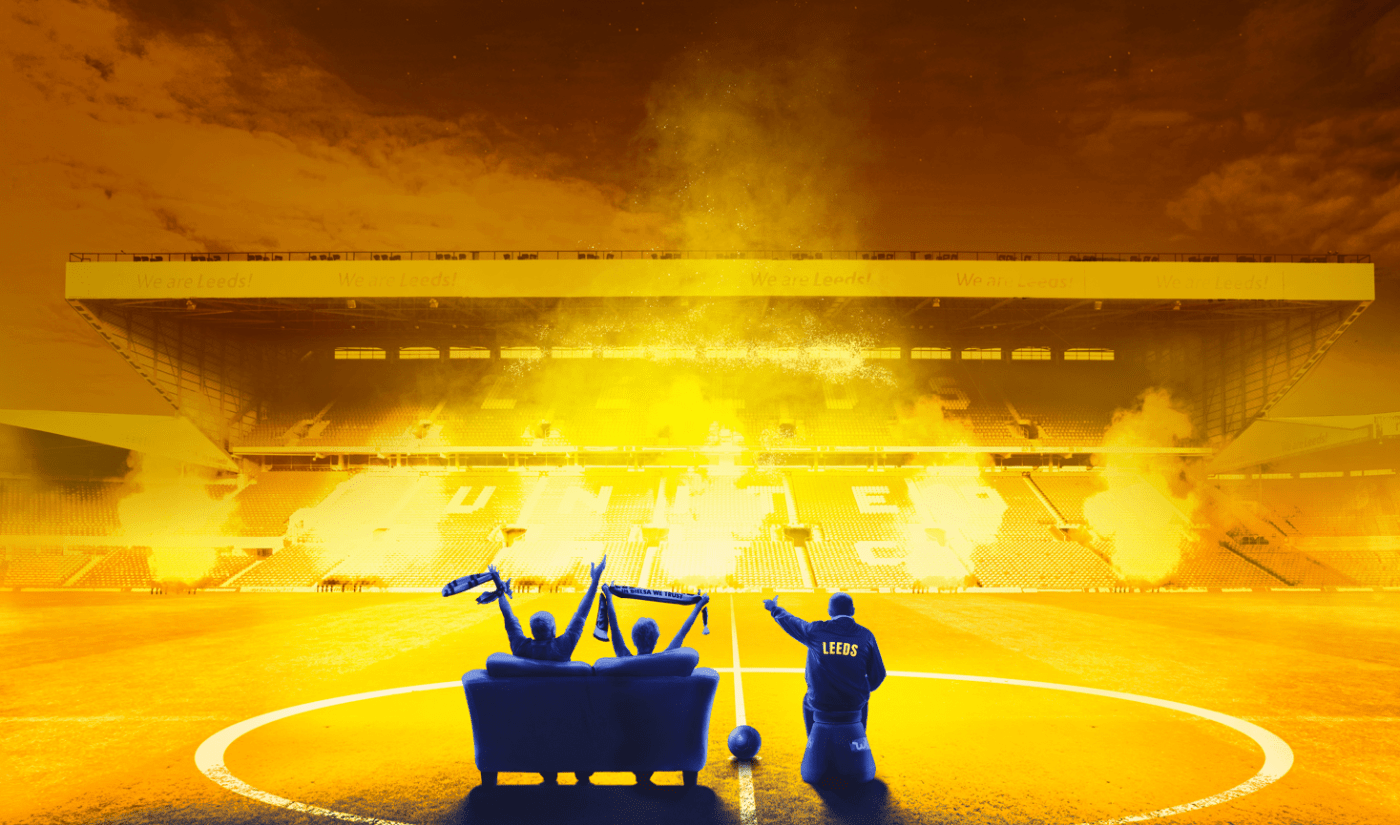
Before I get into the nuts and bolts of the review of this play, I would just like to say one thing. Go and see it! It works on so many levels, football being the mortar which binds the whole building, but you really don’t need to be a fan, in fact, it being press night, a lot of the people I spoke to had no interest in either the game, or Leeds United. It is touching, incisive and funnier than anything I have seen for ages and the acting beyond brilliant.
Trigger warning! I am now going to give some background information on the post-war history of Leeds United, which I hope will be of assistance in your understanding of the mentality of their fans, the basis for the piece. It contains some upsetting language with frequent use of the term ‘runners-up’. Should you be of a nervous disposition please skip to the paragraph after the interior photograph. On the other hand, if you are one of the many people who are not keen on the team, read on and enjoy our pain.
Over the years there can have been no more frustrating team to follow than Leeds United. My first trip to Elland Road was with my dad and grandad when I was only about six or seven, but I still vaguely remember it. Actually I wasn’t allowed to forget as my dad would keep reminding me that he was so pleased I got to see John Charles play before he was transferred to Juventus. By the way, that is my grandad’s flat cap I am wearing on my profile picture. At that time the team never bothered the silversmiths, being in Division Two of the Football League. They were promoted to Division One – the top tier in those days – in 1956 but the selling of the aforementioned legend had a hand in their being relegated back to Division Two in 1960.
1961 saw them sign Don Revie as manager, a move which could have been the template for the appointment of the focus of the play, Marcelo Bielsa, as both men were meticulous in their preparation for games and master tacticians. Revie only saved them from relegation to Division Three when they won their last match of the season. A spectacular change of fortune – and colours, from blue and gold to all white – led to their promotion back to the top flight in 1964, by beating West Bromwich Albion away, a game I went to on a supporter’s coach, which was a lot rowdier on the way back than it had been on the outward leg.
The meteoric rise continued and, in their first season back at the top, they began to give a hint of things to come by coming second in the league to Manchester United on goal average and being beaten in the FA Cup Final by Liverpool, another game I went to with my dad. Not only did we lose but it went to extra-time in the pouring rain, an experience made worse by Wembley not having a roof in those days.
I won’t bore you any more with game by game memories, but the next several years with Leeds playing really well and getting to finals without winning a trophy, leading to the joke of the time about the merchandise shop selling Leeds United bras – great support but no cups. The spell was eventually broken by winning the League Cup and the Inter-Cities Fairs Cup in 1968. The following year they added the League title and then it was back to form, losing more trophies at the last hurdle; the FA Cup in 1972 being an exception. In 1973 the club challenged for the treble, League title, FA Cup and European Cup but failing at the last gasp in all three.
To sum up how frustrating being a United fan was in the Revie Years, they were First Division Champions twice and Runners-up five times; FA Cup Winners once, losing finalists three times; League Cup Winners once and runners-up once; European Cup Runners-up once; European Cup Winners’ Cup Runners-up once; Inter-Cities Fairs Cup Winners twice and runners-up once. When this last competition was scrapped in a European football competition shake-up they decided to have a play-off between the previous winners to see who would keep the trophy. Guess who were runners-up!
After that there were the odd successes, including winning the last ever Division One title before the Premier League was founded. The general trend, however, was unmet expectations, until there came a time when even they were lowered as the side was relegated again.
A succession of financial shenanigans at the beginning of the century meant deducted points and the club ending up in the third tier of the structure for the first time ever. In 2010 they had clawed their way back to the Championship, now the second tier of the game, but another series of dodgy characters and deals meant the club was floundering.
Finally, in 2018, the club was sold to 49ers Enterprises, the owners of the American Football team the San Francisco 49ers, who brought expertise and stability to the organisation as well as some legitimate cash enabling them to hire Marcelo Bielsa as the club’s highest ever paid manager and being able to strengthen the squad. This, my friends, is where the story begins.
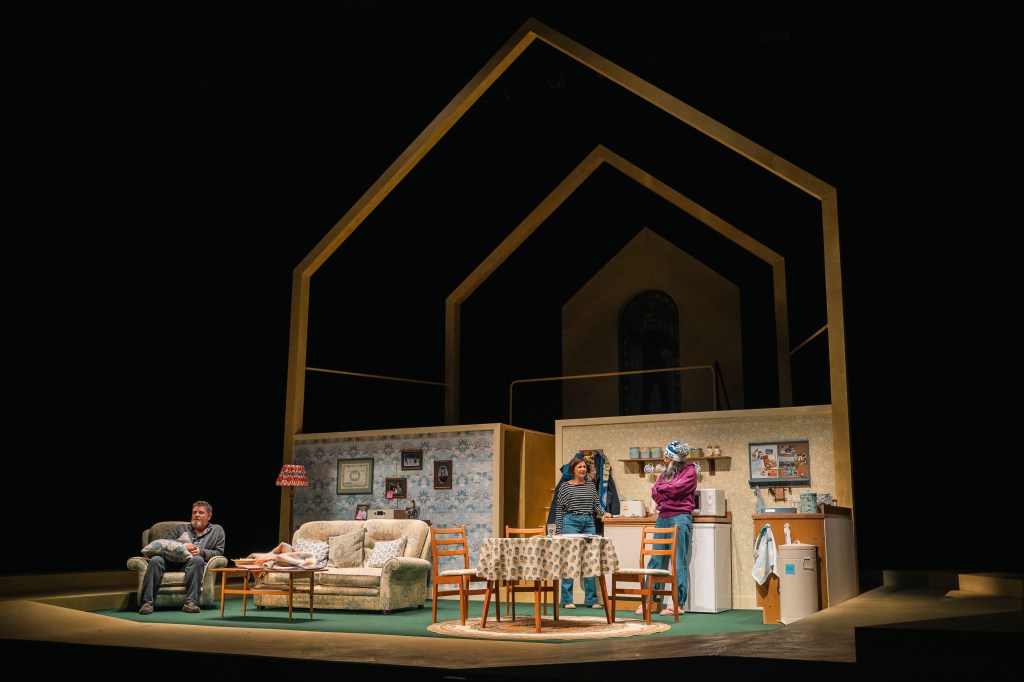
Howard – Reece Dinsdale, Hazel – Natalie Davies and Sue, played by Shobna Gulati, in their house, which also covered as a pub, a church, Corner Flag Café, Elland Road Stadium, Wetherby Morrison’s and the Empire State Building. OK, that last one isn’t true but I am sure that Set and Costume Designer, Amanda Stoodley, could have made it happen if asked.
The opening scene finds Howard, played by Reece Dinsdale, looking at some framed family photographs on the sideboard. One, of Hazel, bears a Post-It Note saying ‘Daughter. Don’t ask if she is attached yet!’ This is the first hint we get that something is amiss. On looking at the kitchen section of the house, there are some containers and unit doors similarly labelled with the contents. At this point Howard seems to be more forgetful than ill, but, as the timeline progresses, so does the dementia, which is the reason for the visual aids.

Howard, Reece Dinsdale and Hazel, Natalie Davies, having an intimate father/daughter moment. Note the sticker on the photo.
Sue, Howard’s wife, brilliantly brought to life by Shobna Gulati, also morphs from being the loving, concerned spouse, who is managing to keep everything under control, to becoming a full-time carer. The third family member, the aforementioned Hazel, Natalie Davies, at first seems almost oblivious to the seriousness of her father’s condition, regarding it as a bit of a nuisance, but, as time passes and lockdown is imposed, she has to take the carer’s role when Sue is admitted to hospital, having gone down with the virus. She begins to relish the situation and uses the time with her dad to the benefit of them both. Fortunately, Sue recovers and the family is united – pun definitely intended.
One of the features of dementia is the tricks it plays on the memory, perfectly illustrated by an episode when Hazel has exaggerated her culinary skills to her workmates, and invited five of them to hers for a meal, even though she even needs a recipe for toast. As she is asking Sue for help, Howard keeps asking the same question repeatedly, but when Sue suggests Hazel make his version of chilli he recites the lengthy list of ingredients and cooking instructions with more clarity of thought than Gordon Ramsey, and in more passable language.

Reece Dinsdale as Howard and Shobna Gulati as Sue
If this is sounding a bit heavy, the way it is written, by Chris O’Connor, alleviated the mood to one of positivity and even levity, walking the tightrope of being sympathetic, without being patronising or maudlin. It was incredibly skilful. The humour which arose from Howard’s mistakes was also handled in a way that made the audience laugh with him rather that laugh at him.
Speaking of humour, the other two actors in the piece, both of whom took multiple roles, were splendid. They were Dean Smith and Everal A Walsh.
The parallel plot was that of the rise of Leeds United after the appointment of Marcelo Bielsa. It was in inverse trajectory to that of Howard’s situation. The sweet spot occurring at the end of Bielsa’s first season, when Howard and Sue were still going to the matches, and the club narrowly missing promotion – again; to the end of the following campaign which saw the team attain Premier League status, but Howard become oblivious to reality.
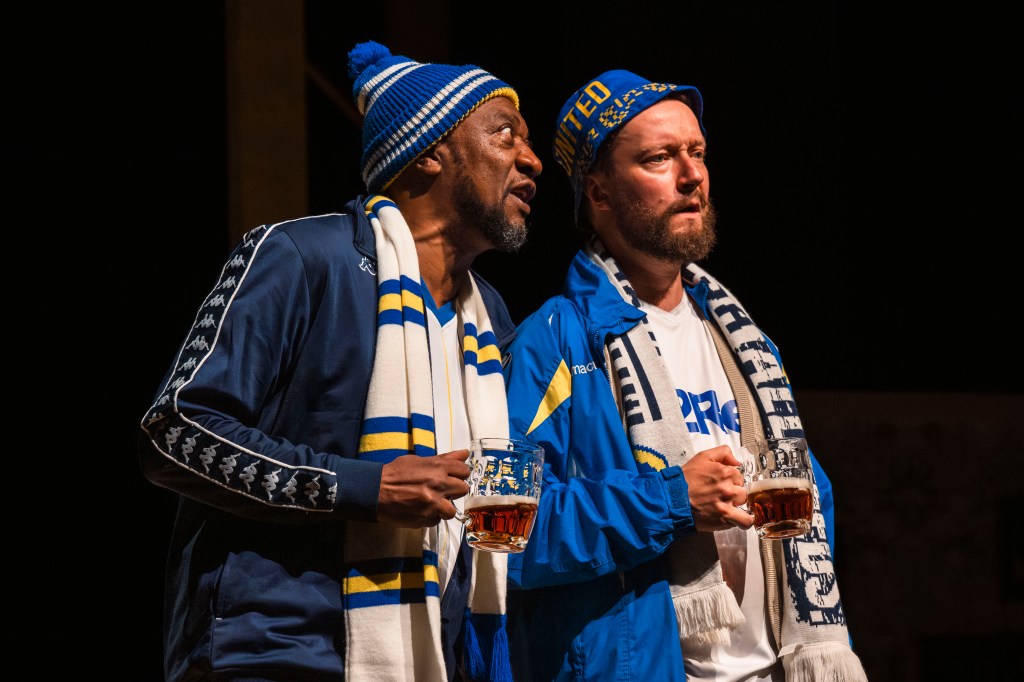
So, two men go into a pub, and one says……… Everal A Walsh and Dean Smith as two supporters the first a diehard and the other fair-weather. Both hilarious.
The United story was told through the various characters portrayed by Messrs Smith and Walsh. They were two of the club’s management team, ran a podcast and sat in a pub arguing over the niceties of the team and its shortcomings. The jokes and put-downs were amazingly witty, so much so that I could not do them justice in text, they have to be seen live. The podcast alternated between euphoria and despair, both moods having an influence on how the benefits of the wares of their sponsors, Sharkskin Underpants and a positive thinking clinic, were described.

It takes two to tango. Dean Smith as Argentinian, Marcelo Bielsa in his playing days, and Shobna Gulati as Sue.
There were a couple of set pieces which had the place in uproar. Sue had a major crush on the Leeds manager, so much so that she took every opportunity to visit the Wetherby branch of Morrison’s Supermarket, where he was in the habit of doing his shopping. This led to a dream in which she met him, played by Dean Smith, and they danced the tango round the front room. The overstated eroticism and choreography were a scream.
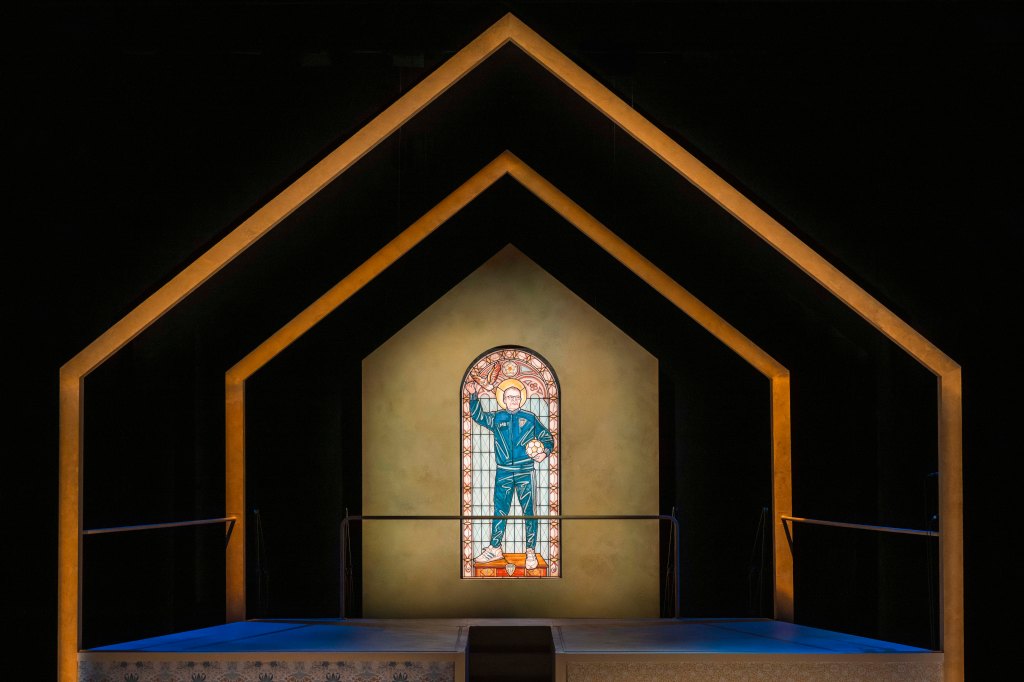
The church of St Marcelo of Elland Road.
The second involved Everal A Walsh who took to praying just before the end of the second Bielsa season, to ask that the Almighty help United win. It was done in front of a stained glass window bearing an image of Marcelo himself, and ended in the most side-splitting reason I have ever heard for the Deity to help a Yorkshire team. He also had another killer line, ‘Happy, happy, of course I’m not happy, I’m a f***ing Yorkshireman.’ Yes, there are a few F bombs dropped, but we are dealing with football here, not croquet on the lawn with cucumber sandwiches – sans crust.
The authenticity brought to the production by all concerned, especially Director, Gitika Buttoo, was amazing, the involvement of Dialect Coach, Rosemary Berkon and Theatre and Dementia Consultant, Dr Nicky Taylor, made you forget that the cast were actors, it seemed as though we were in their world, and they in ours. I can’t leave out Lighting Designer, Jason Taylor; Sound Design and Composer, Annie May Fletcher; Movement Director, Neil Bettles and Casting Director, Lucy Casson CDG, it would have been plain rude had I done so.
It is matter of record that, after the promotion in question Marcelo Bielsa was sacked in 2022 following a string of poor results and in 2023 Leeds United were relegated again to the Championship. I hate to end on a downbeat note – so I won’t. Last month, under the managership of Daniel Farke, they were promoted back to the Premier League as Champions. For once, not runners-up!
Returning to the subject of dementia, there were a couple of scenes in the Corner Flag Café, which is at the football ground in Elland Road. They have meetings for those suffering from this insidious condition and, again, Smith and Walsh made the meetings look very enjoyable. In fact, Leeds United and Leeds Playhouse co-run Leeds Dementia Engagement and Empowerment Project (DEEP) to help sufferers and their families.
Through It All Together is at Leeds Playhouse until 19th July and I can’t recommend it highly enough. I guarantee that you will have tears in your eyes, 90% of which will be caused by laughter and the balance because the seats are uncomfortable, they aren’t, but that was my excuse for blubbing. For information and tickets go to https://www.leedsplayhouse.org.uk/event/through-it-all-together/ Performances are at various times during the day or evening and some are dementia friendly.
Photographs by Charlie Swinbourne
Footnote. I have just been onto the Leeds United website to check something and was saddened to see the announcement of the death of Alan Peacock. He scored the goal against West Bromwich Albion which sent them back into the First Division on the night in 1964 which I referred to earlier RIP

